When PCB designers encounter EMI compliance failures above 1 GHz, traditional conductive shielding — metal cans, spring finger gaskets, and plated enclosures — often reaches its practical limits. At these frequencies, wavelength shrinks to centimeters, and even sub-millimeter apertures become effective ante
as. This is where ferrite sheet EMI absorbers enter the solution space, offering a fundamentally different noise suppression mechanism based on magnetic loss rather than conductive reflection.
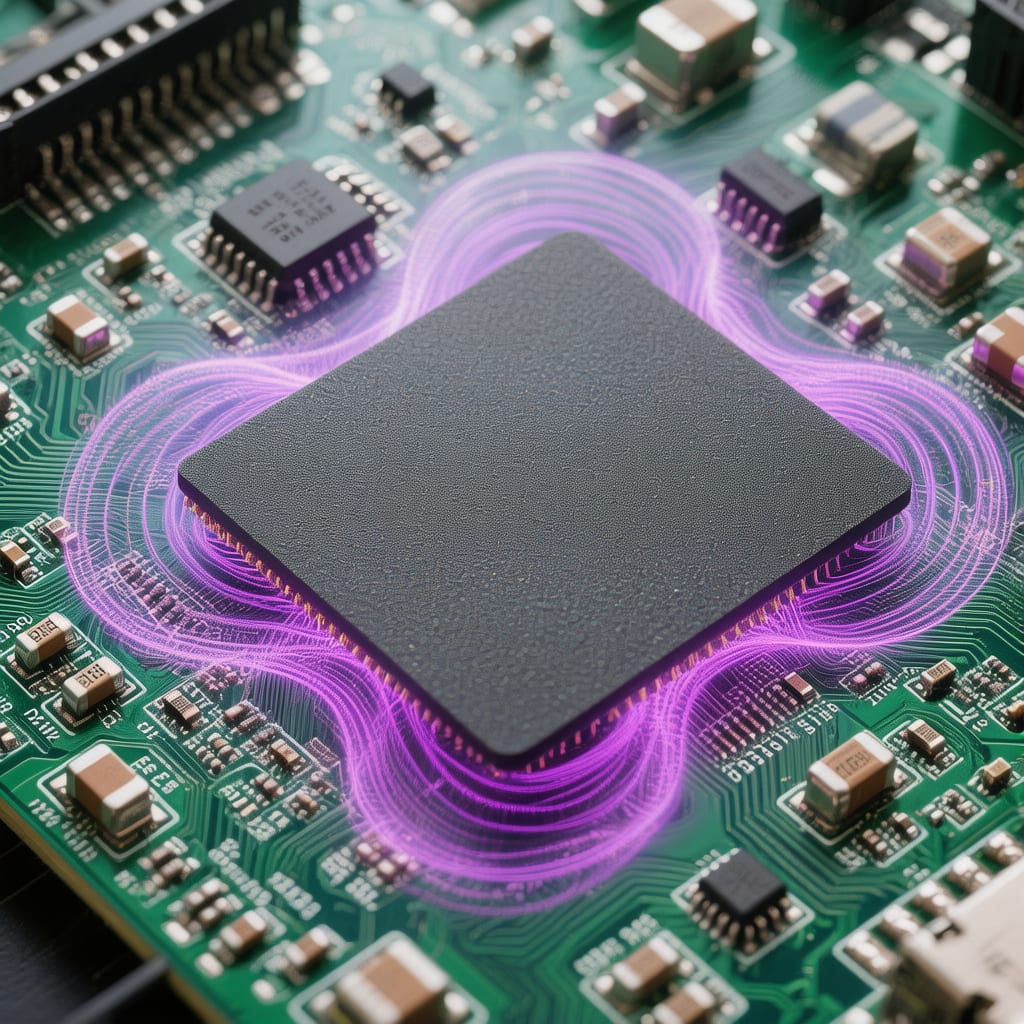
Unlike copper or nickel-based shields that reflect electromagnetic energy, ferrite absorbers convert incident RF energy into negligible heat through magnetic hysteresis and domain wall resonance. This makes them uniquely effective at suppressing high-frequency common-mode noise on SMT PCBs where conductive shields would simply redirect the noise elsewhere.
How Ferrite EMI Absorbers Work
Ferrite sheets are composite materials consisting of magnetic oxide particles (typically Mn-Zn or Ni-Zn ferrite) dispersed in a flexible polymer binder. When an electromagnetic wave encounters the ferrite layer, two loss mechanisms activate:
1. Magnetic Hysteresis Loss: The alternating magnetic field component of the EM wave causes the ferrite’s magnetic domains to realign with each cycle. This domain wall motion encounters resistance (coercivity), dissipating energy as heat. This mechanism dominates below approximately 300 MHz.
2. Domain Wall and Spin Resonance: At microwave frequencies (1–10 GHz), the ferrite’s natural magnetic resonance absorbs energy when the applied frequency matches the precession frequency of electron spins in the crystal lattice. Ni-Zn ferrites are specifically engineered to place this resonance peak within target frequency bands.
The key material property is complex permeability (μ = μ’ − jμ″), where the imaginary part μ″ represents magnetic loss. High-performance EMI absorber sheets achieve μ″ values of 15–30 at 1 GHz, compared to near-zero μ″ for non-magnetic materials.
Comparing Magnetic Absorption vs Conductive Shielding
| Parameter | Ferrite Absorber | Metal Shield Can |
|---|---|---|
| Noise suppression mechanism | Absorption (magnetic loss) | Reflection (conductive barrier) |
| Effective frequency range | 100 MHz – 10 GHz | DC – 3 GHz (aperture-limited) |
| Thickness | 0.05–2.0 mm | 0.1–0.3 mm (metal) + air gap |
| Near-field coupling suppression | Excellent (absorbs H-field) | Limited (redirects, may couple elsewhere) |
| Weight | Light (polymer matrix) | Moderate (metal) |
| Cavity resonance risk | None (non-conductive) | Significant (creates resonant cavities) |
| Cost at volume | $0.05–0.30/cm² | $0.02–0.15/cm² (simple stamping) |
Application Methods on SMT PCBs
1. Surface-Mount Ferrite Sheets
Pre-cut ferrite sheets with pressure-sensitive adhesive (PSA) backing are applied directly onto IC packages, flex cables, or PCB regions where near-field emissions are concentrated. Typical thickness ranges from 0.1 mm to 1.0 mm, with thi
er sheets preferred for maintaining Z-height clearance in compact designs. Application directly over BGA packages and high-speed digital ICs reduces radiated emissions by 3–8 dB in the 1–6 GHz range.
2. Embedded Ferrite Layers
For high-volume production, ferrite-filled prepreg or ink can be integrated into the PCB stack-up itself. This approach places the absorber material in intimate contact with noise sources — directly above or below high-speed signal layers — maximizing coupling efficiency. Embedded ferrite layers achieve 5–12 dB suppression at targeted frequencies but add approximately 15–25% to raw board cost.
3. Cavity Resonance Damping
Metal shielding enclosures create resonant cavities between the shield and PCB ground plane. At cavity resonance frequencies, shielding effectiveness can drop to near zero or even become negative (amplification). Applying ferrite absorber patches at calculated anti-node positions inside the cavity damps these resonances, restoring 10–20 dB of shielding performance at previously problematic frequencies.
Material Selection by Frequency Band
Mn-Zn Ferrite (100 MHz – 1 GHz): Higher initial permeability (μ’ = 800–2000), excellent for conducted EMI on power lines and low-frequency common-mode chokes. Limited above 1 GHz due to falling μ″.
Ni-Zn Ferrite (500 MHz – 10 GHz): Moderate permeability (μ’ = 50–200) but maintains high μ″ into microwave frequencies. The standard choice for radiated EMI suppression on high-speed digital boards, 5G front-end modules, and automotive radar PCBs.
Hexaferrite Composites (1–40 GHz): Barium and strontium hexaferrite particles exhibit ferromagnetic resonance at millimeter-wave frequencies. Emerging applications include 77 GHz automotive radar and 28 GHz 5G mmWave ante
a modules, though material cost remains 3–5× that of Ni-Zn sheets.
Design Guidelines for Maximum Effectiveness
- Placement proximity matters: Absorption effectiveness follows an inverse-square relationship with distance. Place ferrite sheets within 0.5 mm of the noise source for maximum coupling. Even a 0.1 mm air gap between sheet and IC package reduces suppression by 2–3 dB.
- Thickness vs frequency trade-off: Thicker sheets (>0.5 mm) improve low-frequency performance; thi
er sheets (<0.2 mm) maintain effectiveness at higher frequencies. For broadband suppression (1–6 GHz), a 0.2–0.3 mm Ni-Zn sheet provides the best cost-performance balance.
- Avoid ground plane contact: Ferrite sheets are electrically non-conductive but magnetically active. Contact with grounded copper pours can create unintended capacitive coupling paths. Maintain ≥0.1 mm isolation from ground fills.
- Verify with near-field sca
ing
: Before and after absorber placement, use near-field H-field probes and spectrum analyzer to quantify suppression at each problem frequency. EMI absorber performance is highly position-dependent and simulation alone rarely captures real-world coupling paths.
For Southeast Asian electronics manufacturers shipping products into regulated markets (FCC Part 15, CISPR 32, EN 55032), ferrite sheet absorbers represent a practical, late-stage EMI fix that can rescue designs from costly board spins. When conductive shielding hits its aperture-limited ceiling above 2–3 GHz, magnetic absorption becomes not just an option but often the only practical noise suppression path short of fundamental layout redesign.