Introduction
The humble copper strip — the raw material for billions of SMT lead frames, co
ector contacts, and EMI shielding components a
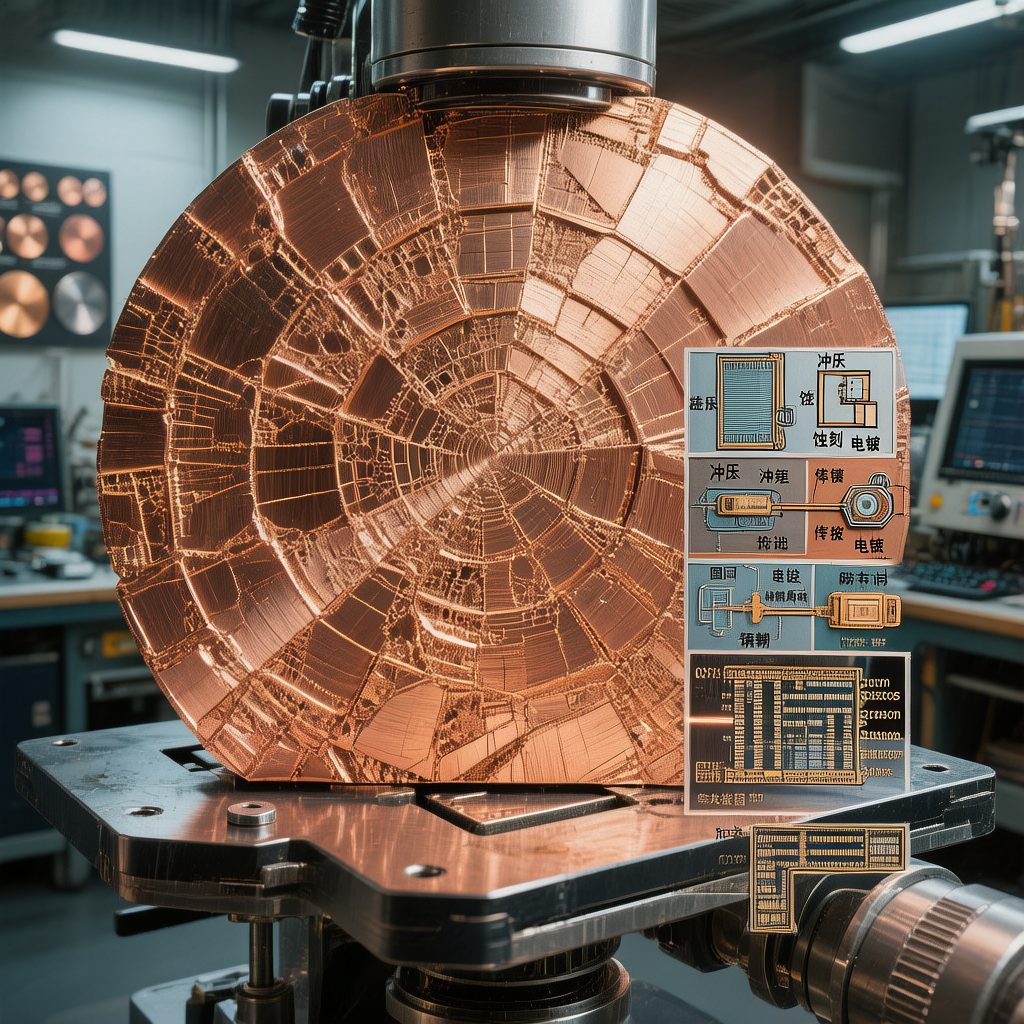
ually — has a hidden complexity that directly impacts manufacturing yield and end-product reliability: its grain structure. The size, orientation, and distribution of crystalline grains within the copper strip determine how it behaves during stamping, forming, and bending operations, and how it performs under thermal and mechanical stress throughout the product lifecycle.
Understanding Grain Structure in Copper Strips
Copper strip is produced by casting, hot rolling, and cold rolling followed by a
ealing. The cold rolling process elongates grains in the rolling direction, creating a worked microstructure with high dislocation density and increased hardness. A
ealing recrystallizes the deformed grains into new, equiaxed grains whose size depends on the a
ealing temperature and duration.
Grain size is typically measured according to ASTM E112 standards and expressed as an ASTM grain size number (G). For electronic-grade copper strips, typical grain sizes range from G=6 (45 µm average diameter) to G=9 (16 µm). The relationship between grain size and mechanical properties follows the Hall-Petch equation: yield strength increases as grain size decreases, proportional to d⁻¹/² where d is the average grain diameter.
Grain Size Effects on Formability
For SMT lead frame forming operations — typically involving 90° bends with tight radii of 0.2-0.5 mm — grain size directly affects the forming outcome:
Fine Grain (G=8-9, 16-22 µm)
- Higher yield and tensile strength
- Greater spring-back after forming (requires over-bend compensation)
- Smoother surface finish after forming with reduced orange peel texture
- Better fatigue resistance for applications with cyclic loading
- Recommended for thin strips (0.1-0.3 mm) and fine-pitch lead frames
Coarse Grain (G=5-6, 45-64 µm)
- Lower yield strength and better ductility
- Reduced spring-back, enabling tighter bend radii
- Potential for orange peel surface texture on formed surfaces
- Lower fatigue strength under cyclic loading
- Suitable for thicker strips (>0.5 mm) and large-radius bends
Spring-Back Prediction and Compensation
Spring-back — the elastic recovery of the material after forming — is one of the most critical parameters in lead frame tooling design. For a 90° bend in copper alloy strip, spring-back typically ranges from 2° to 8°, depending on the material condition. The relationship is governed by the ratio of yield strength to elastic modulus (σy/E): higher ratios produce greater spring-back.
Tool designers compensate for spring-back by over-bending — designing the forming die to produce a bend angle greater than 90° so that after spring-back, the final angle is correct. Accurate spring-back prediction requires knowledge of the copper strip’s specific grain size and work-hardening characteristics, not just generic material properties from the datasheet.
A
ealing Process Optimization
The a
ealing process — whether batch a
ealing in a bell furnace or continuous strand a
ealing — determines the final grain structure. Key process parameters include:
- A
ealing temperature:
For C11000 ETP copper, recrystallization begins at approximately 200-250°C, with grain growth accelerating above 400°C. The temperature must be high enough for complete recrystallization but low enough to prevent excessive grain growth. - A
ealing time:
Grain growth follows a parabolic relationship with time at temperature. Doubling the aealing time increases grain size by approximately 40%.
- Prior cold work: The degree of cold reduction before a
ealing determines the driving force for recrystallization. Higher cold reduction produces finer recrystallized grains at a given a
ealing temperature.
Reliability Implications
Grain structure affects long-term reliability through several mechanisms:
Thermal fatigue: During temperature cycling (-40°C to +125°C, typical for automotive qualification), the mismatch in coefficient of thermal expansion (CTE) between the copper lead frame and the PCB induces cyclic stress. Fine-grained copper exhibits better resistance to thermal fatigue crack initiation because grain boundaries impede dislocation movement and crack propagation.
Stress relaxation: For co
ector contacts that rely on spring force for reliable electrical co
ection, coarse-grained copper exhibits faster stress relaxation at elevated temperatures. Fine-grained material maintains contact force more consistently over the product lifetime, particularly in under-hood automotive applications.
Conclusion
The grain structure of copper strip is not merely a metallurgical curiosity — it is a design parameter that directly influences SMT lead frame manufacturability and reliability. For fine-pitch, high-reliability applications, fine-grained copper strip (G=8-9) provides the optimal balance of formability, fatigue resistance, and stress relaxation behavior. Specifying grain size alongside mechanical properties in procurement documentation ensures consistent forming performance across material lots and suppliers, reducing tooling adjustments and improving first-pass yield in high-volume SMT assembly operations.