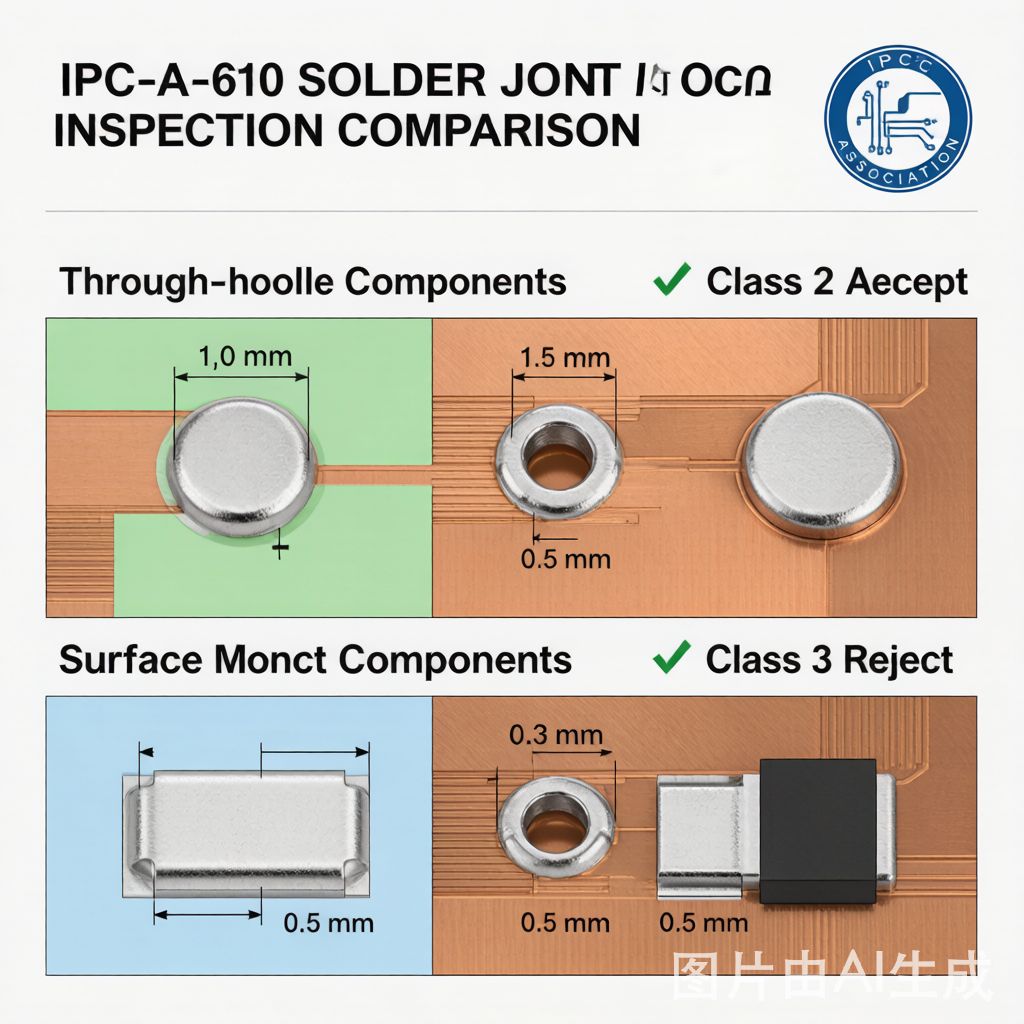
Why IPC-A-610 Is the Gold Standard for Solder Joint Inspection
IPC-A-610 “Acceptability of Electronic Assemblies” is the most widely referenced inspection standard in the electronics manufacturing industry, used by over 100,000 certified inspectors worldwide. It defines three product classes with progressively stricter acceptance criteria:
- Class 1 (General Electronic Products): Consumer electronics where cosmetic defects are acceptable and the primary requirement is function. Minimal inspection criteria.
- Class 2 (Dedicated Service Electronic Products): Industrial, telecom, and automotive electronics where extended life and reliable operation are required. Moderate inspection criteria—the most common class for Southeast Asian electronics manufacturing.
- Class 3 (High-Performance Electronic Products): Military, aerospace, medical, and high-reliability applications where continuous performance and survivability are critical. The strictest criteria with the tightest dimensional tolerances.
Understanding the specific fillet dimension requirements for Class 2 vs. Class 3 is essential for inspectors, process engineers, and quality managers who must make accept/reject decisions on production assemblies every day. This article covers the key dimensional criteria for the most common joint types, with practical measurement guidance and defect identification.
SMT Chip Component Fillet Criteria (0402, 0603, 0805)
Fillet Height Requirements
For rectangular chip components (resistors, capacitors) soldered to PCB pads, IPC-A-610 specifies fillet height criteria based on the component termination height:
- Class 2 minimum: Fillet height must be visible (discernable with 10× magnification) on the component end termination. The fillet must extend at least to the top edge of the termination, but does not need to reach the component body top surface. Practically, the fillet height should be ≥25% of the component termination height.
- Class 3 minimum: Fillet height must extend to the top of the component termination (≥50% of the termination height for rectangular chips). The fillet should be visible along the entire width of the termination end face.
- Maximum fillet height: The fillet should not extend onto the component body top surface for either class—solder on the body indicates excessive paste volume or misplaced deposit.
Fillet Width Requirements
- Class 2 minimum: Side fillet length (the distance the fillet extends along the component length direction from the pad edge) must be visible but has no minimum dimensional requirement. The end fillet (on the termination face) must be visible across at least 75% of the termination width.
- Class 3 minimum: Side fillet must extend at least 25% of the component pad length from the pad edge toward the component center. The end fillet must be visible across 100% of the termination width.
Common Defect Indicators for Chip Components
- Insufficient fillet height (Class 2 reject, Class 3 defect): Fillet not visible on the termination end face. Root causes: inadequate solder paste volume, poor pad wetting, or component placement offset reducing the overlap between component termination and pad.
- Missing side fillet (Class 2 process indicator, Class 3 defect): No visible side fillet along the component length. Root causes: insufficient paste volume, narrow pad width, or poor solderability of the termination or pad.
- Bulbous fillet (Class 2 process indicator): Excessively thick fillet that extends beyond the pad boundary. Not a reject for Class 2 unless it bridges to an adjacent pad. Indicates excessive paste volume.
Gull-Wing Lead Fillet Criteria (QFP, SOIC)
Toe Fillet Requirements
The toe fillet is the solder co
ection at the lead tip (the end of the gull-wing that contacts the pad farthest from the component body):
- Class 2 minimum: Toe fillet must be visible. No minimum length requirement—the lead tip merely needs to show wetting evidence.
- Class 3 minimum: Toe fillet must extend at least 0.5 mm beyond the lead toe (or to the pad edge if the pad extends less than 0.5 mm beyond the lead). This requires adequate pad length extension beyond the lead footprint.
Heel Fillet Requirements
The heel fillet is the solder co
ection at the lead bend point (where the gull-wing transitions from vertical to horizontal):
- Class 2 minimum: Heel fillet must be visible and fill the concave area at the lead bend. The heel fillet height must extend at least halfway up the vertical portion of the lead.
- Class 3 minimum: Heel fillet must fill the concave area completely and extend up the vertical lead portion. The heel fillet is typically the strongest part of a gull-wing joint and must be fully formed for Class 3 acceptance.
Side Fillet Requirements
- Class 2 minimum: Side fillet must be visible along at least 50% of the lead width on each side of the lead.
- Class 3 minimum: Side fillet must be visible along the entire lead width on each side. For fine-pitch leads (≤0.5 mm pitch), side fillets may be thin but must show wetting across the full lead-to-pad contact area.
Lead Coplanarity and Its Effect on Fillet Quality
Lead coplanarity (the flatness of all gull-wing leads relative to a reference plane) directly affects fillet quality. If leads are not coplanar, some leads sit higher above their pads than others, resulting in thi
er paste contact and smaller fillets on the high leads:
- Class 2: Maximum lead coplanarity offset of 0.10 mm per JEDEC MO-048. Leads exceeding this offset may still be acceptable if the minimum fillet criteria are met on each individual lead.
- Class 3: Maximum coplanarity offset of 0.075 mm. All leads must meet the minimum fillet dimensions—no exceptions for coplanarity-related fillet reduction.
Through-Hole Solder Joint Criteria
Vertical Fill Requirements
The most critical through-hole criterion is the percentage of the hole barrel filled with solder:
- Class 2 minimum: 75% vertical fill (solder must fill at least 75% of the hole depth from the component side). The top side (opposite the component) must show wetting evidence—a visible fillet or meniscus—but does not need to be fully filled.
- Class 3 minimum: 100% vertical fill (solder must fill the entire hole depth). Both the component side and the top side must show complete fill with visible fillets. For Class 3, any voiding in the hole fill must not exceed 25% of the hole cross-sectional area, and no single void may exceed 10% of the area.
Fillet Requirements on Top and Bottom Sides
- Bottom side (component side): Both Class 2 and Class 3 require a visible fillet that covers at least 90% of the pad area around the hole. The fillet should wet smoothly from the lead to the pad edge.
- Top side (solder side): Class 2 requires visible wetting evidence (meniscus or partial fillet). Class 3 requires a full fillet covering ≥90% of the pad area, with the fillet concavity smoothly wetted from the lead surface to the pad edge.
Wetting Angle Criteria
The solder wetting angle (the angle between the solder fillet surface and the lead or pad surface) indicates the quality of the metallurgical bond:
- Class 2: Wetting angle ≤90° (convex or flat fillet is acceptable). A wetting angle >90° (concave, non-wetting) indicates poor solderability and is a defect.
- Class 3: Wetting angle ≤60° preferred, ≤90° acceptable. Any wetting angle >90° is a defect regardless of fillet dimensions.
Practical Fillet Measurement Methods
Visual Inspection (10× Magnification)
Most IPC-A-610 inspection is performed visually with 10× magnification using a stereo microscope or magnifier lamp. The inspector evaluates fillet visibility, coverage area, and wetting quality against the criteria described above. For chip components and gull-wing leads, visual inspection is sufficient for Class 2 and Class 3 acceptance decisions on fillet presence and coverage.
Key visual inspection technique: tilt the board under the microscope to view the fillet profile from multiple angles. A fillet that appears adequate when viewed from above may reveal insufficient heel height or wetting gaps when viewed from a 30–45° angle.
X-Ray Inspection for Hidden Joints
For joints that ca
ot be visually inspected (BGA balls, QFN bottom-side terminations, through-hole fill from the top side), X-ray inspection is required:
- BGA solder ball diameter: Class 2 requires visible ball formation and co
ection to both the component and pad. Class 3 additionally requires the ball diameter to be within ±20% of the nominal design diameter after reflow.
- QFN side termination wetting: Class 2 requires wetting evidence on ≥50% of the termination length. Class 3 requires wetting on ≥75% of the termination length.
- Through-hole fill verification: X-ray provides an accurate vertical fill percentage that visual inspection from either side ca
ot determine. Use X-ray for Class 3 through-hole fill verification on critical co
ectors and power components.
Dimensional Measurement for Tight Tolerances
For Class 3 acceptance on fillet dimensions that have specific minimum values (e.g., toe fillet length ≥0.5 mm), dimensional measurement with a calibrated optical comparator or AOI system is required. The measurement system must have resolution of at least 0.01 mm and be calibrated per IPC-9197 (SPC for electronic assemblies).
Process Indicators vs. Defects: What to Track and What to Reject
IPC-A-610 distinguishes between “process indicators” (conditions that are acceptable but suggest the process is drifting toward defect territory) and “defects” (conditions that require rework or scrap). Understanding this distinction prevents over-inspection and focuses corrective action where it matters:
- Process indicators (Class 2 acceptable, track for process improvement): Fillet height at the minimum visible threshold, slightly uneven side fillet coverage, minor fillet concavity (wetting angle near 90°), solder ball count of 1–2 per board.
- Class 2 defects (reject, rework required): Missing fillet on any termination, tombstone, solder bridge, missing heel fillet on gull-wing lead, through-hole fill <75%.
- Class 3 defects (reject, rework required): Any condition that falls below the Class 3 minimum dimensions, plus all Class 2 defects. Additionally: fillet not reaching the top of chip component termination, toe fillet <0.5 mm, side fillet not covering full lead width, through-hole fill <100%.
Track process indicators on an SPC chart to identify trends before they become defects. When process indicators cluster at the specification boundary, initiate a process improvement action (adjust paste volume, reflow profile, or placement accuracy) rather than waiting for actual defects to appear.
Conclusion
IPC-A-610 solder fillet inspection criteria provide a rigorous, standardized framework for making accept/reject decisions on electronic assemblies. The distinction between Class 2 and Class 3 is not merely stricter numbers—it reflects fundamentally different reliability expectations that drive different process control investments. Class 2 products require fillet visibility and adequate wetting; Class 3 products require specific minimum fillet dimensions and 100% through-hole fill. For both classes, the key to consistent inspection is: know the criteria for your product class, use appropriate magnification and measurement tools, distinguish process indicators from defects, and feed inspection data back to the process engineers for continuous improvement. When inspectors and process engineers work together with IPC-A-610 as the common reference, defect rates drop and inspection consistency improves—making the standard a practical tool for quality improvement, not just a compliance checkbox.