Why Tg Matters in the Lead-Free Era
The transition from SnPb eutectic (183°C melting) to SAC305 lead-free solder (217–220°C melting, 235–250°C peak reflow) increased the thermal stress on PCB laminates by approximately 35–40°C. This seemingly modest temperature increase pushed standard FR-4 laminates (Tg ≈ 130–140°C) beyond their reliable operating window, triggering a cascade of latent defects: pad cratering, PTH barrel cracking, i
er-layer delamination, and CAF (conductive anodic filament) formation.
Selecting the right copper clad laminate (CCL) with an appropriate glass transition temperature is now one of the most consequential material decisions in PCB fabrication. This article explains the science behind Tg, its relationship to CTE and reliability, and the practical trade-offs between different laminate grades.
What Is Tg and What Happens When You Exceed It?
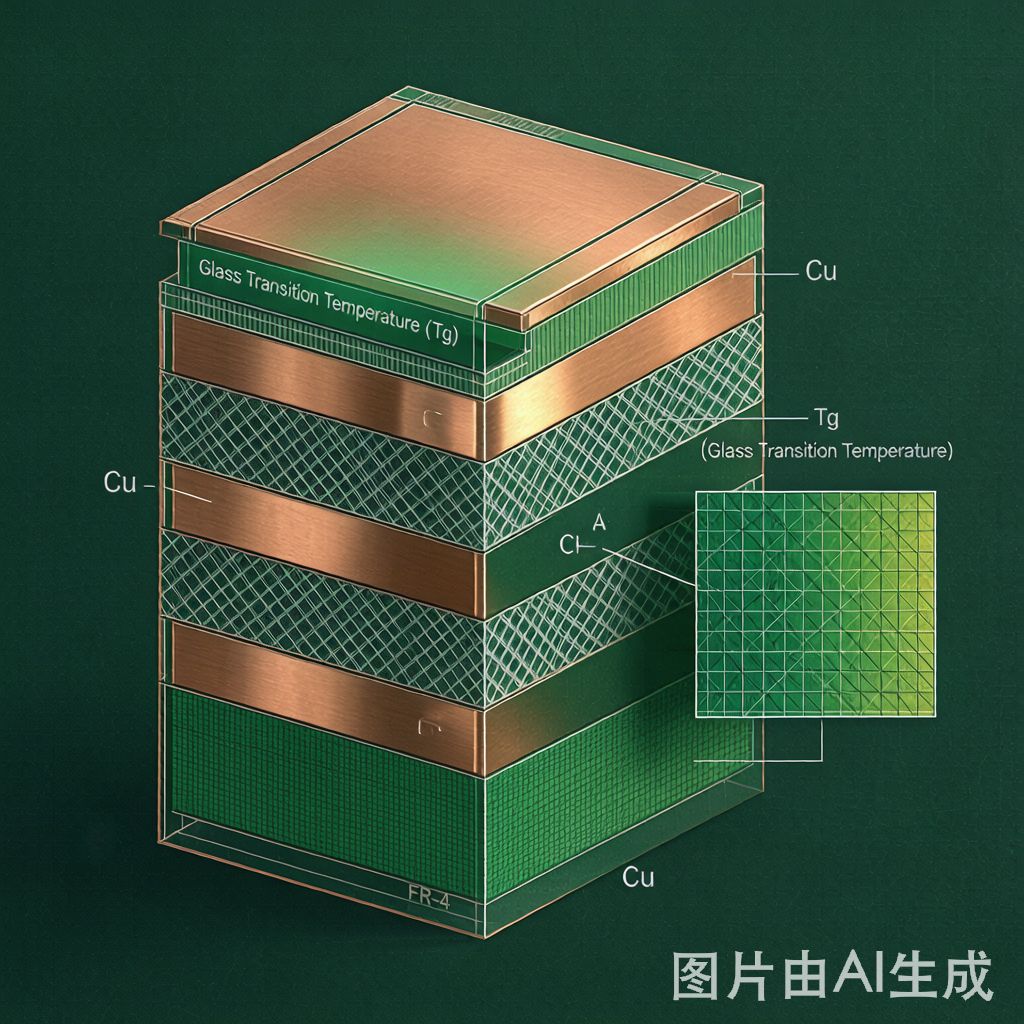
The glass transition temperature (Tg) is the temperature at which a polymer transitions from a rigid, glassy state to a softened, rubbery state. In PCB laminates, the epoxy resin matrix undergoes this transition while the glass fiber reinforcement maintains in-plane dimensional stability.
The CTE Jump at Tg
Below Tg, the CTE in the Z-axis (through-thickness) of a typical FR-4 laminate is 45–65 ppm/°C. Above Tg, this jumps to 250–350 ppm/°C—a 5–6× increase. During lead-free reflow, the board spends 45–90 seconds above the lower-end Tg of standard FR-4, subjecting copper-plated through-holes (PTHs) to extreme Z-axis expansion.
Copper has a CTE of approximately 17 ppm/°C. The CTE mismatch between the expanding laminate (300 ppm/°C) and the relatively stable copper barrel (17 ppm/°C) generates tensile stress in the copper plating. Cycled over multiple reflow passes and thermal cycles, this stress accumulates as fatigue damage, eventually causing barrel cracking at the knee of the PTH where stress concentrates.
Laminate Grade Comparison for Lead-Free SMT
Standard FR-4 (Tg 130–140°C)
Standard dicyandiamide-cured FR-4 is the workhorse of the PCB industry but has significant limitations in lead-free applications. The low Tg means the board spends the entire reflow peak zone above Tg, maximizing the time in the high-CTE regime. Additionally, standard FR-4 exhibits higher moisture absorption (0.15–0.20%), which can cause delamination during reflow as absorbed water vaporizes.
Applications: Single-sided or simple double-sided boards, consumer products with limited thermal cycling requirements, low-layer-count designs (≤4 layers). Not recommended for boards exceeding 4 layers or any design with PTH aspect ratios above 6:1.
Mid-Tg FR-4 (Tg 150–160°C)
Mid-Tg laminates use phenolic-cured epoxy systems that push the glass transition 10–25°C higher than standard FR-4. While still below the SAC305 peak reflow temperature, the reduced time above Tg (typically 20–40 seconds instead of 60–90 seconds) translates to measurably lower PTH fatigue damage.
Z-axis CTE above Tg: 200–280 ppm/°C (25–40% lower than standard FR-4)
Applications: 4–8 layer boards in consumer electronics, telecom CPE, and general industrial controls. Cost premium over standard FR-4: 15–25%.
High-Tg FR-4 (Tg 170–180°C)
High-Tg FR-4 employs multifunctional epoxy or phenolic-novolac resin systems. With Tg above 170°C, the board reaches its transition temperature only briefly (if at all) during SAC305 reflow, spending most of the profile below Tg where CTE is well-behaved.
PTH reliability: Testing per IPC-TR-579 shows that high-Tg FR-4 survives 6–8× more thermal cycles before PTH barrel cracking versus standard FR-4 under identical lead-free reflow conditions.
Applications: Multilayer boards (8–20+ layers), automotive electronics, server/storage PCBs, and any board with PTH aspect ratios above 8:1. Cost premium over standard FR-4: 30–50%.
Polyimide (Tg ≥ 250°C)
Polyimide laminates offer Tg well above any soldering temperature, effectively eliminating the CTE transition during reflow. The Z-axis CTE remains 45–55 ppm/°C through the entire lead-free reflow profile—roughly equivalent to standard FR-4 below Tg. Polyimide also provides superior CAF resistance and withstands multiple lead-free reflow cycles (e.g., double-side SMT + selective wave) without degradation.
Applications: Military/aerospace, downhole drilling electronics, satellite systems—any application where a single PCB failure is unacceptable. Cost premium: 5–10× over standard FR-4.
Material Selection Decision Matrix
| Criterion | Standard FR-4 | Mid-Tg FR-4 | High-Tg FR-4 | Polyimide |
|---|---|---|---|---|
| Tg (°C) | 130–140 | 150–160 | 170–180 | ≥250 |
| Max lead-free reflow cycles | 2–3 | 4–6 | 6–8 | 10+ |
| PTH reliability (relative) | 1× | 3× | 6–8× | 10+× |
| Moisture sensitivity | High | Moderate | Low | Very Low |
| Relative cost | 1.0× | 1.2–1.3× | 1.3–1.5× | 5–10× |
Practical Guidance for PCB Designers
For the vast majority of SMT assemblies using lead-free solder, high-Tg FR-4 (Tg ≥ 170°C) is the sweet spot between reliability and cost. The decision to use mid-Tg or polyimide should be driven by specific reliability requirements:
- If the board will see more than 5 reflow cycles (double-sided SMT + rework + wave solder), high-Tg is mandatory.
- If PTH aspect ratio exceeds 8:1, high-Tg with a minimum of 25 μm copper plating in the barrel is recommended.
- If the product operates in environments with wide temperature swings (-40°C to +125°C), polyimide or high-Tg with enhanced thermal cycling qualification is prudent.
- Always specify the Tg value and test method (DSC per IPC-TM-650 2.4.25 or TMA per 2.4.24) in the PCB fabrication drawing.
Conclusion
Copper clad laminate Tg selection is not a cost optimization exercise—it is a reliability engineering decision. The incremental cost of moving from standard to high-Tg FR-4 is typically 20–30% of the bare PCB cost, which translates to less than 2% of the total assembly cost. When weighed against the cost of field failures caused by PTH barrel cracking or pad cratering, the investment in an appropriate Tg laminate is among the highest-ROI decisions in SMT manufacturing.