Why Moisture Sensitivity Matters in SMT Assembly
Modern integrated circuit packages—particularly large BGAs, QFNs, and fine-pitch flip-chip BGAs—are highly susceptible to moisture-induced damage during reflow soldering. The plastic mold compound used in IC packaging absorbs atmospheric moisture during storage, and when the package is rapidly heated during reflow (peak temperature 245–260°C), the trapped moisture expands explosively. This internal steam pressure can cause package cracking (called “popcorn” defects because of the characteristic sound), internal delamination between the mold compound and die pad, or bond wire breakage—all leading to electrical failure that may not be detected until field deployment.
JEDEC J-STD-033 is the industry standard governing moisture sensitivity level (MSL) classification, handling, packaging, and baking procedures for SMT components. Understanding and applying J-STD-033 is essential for any electronics manufacturer working with plastic-packaged ICs.
How MSL Classification Works
JEDEC J-STD-020 defines the MSL classification based on accelerated moisture absorption testing. Components are subjected to a soak condition (30°C/60% RH for 168 hours for the lowest level, MSL 1) and then passed through a lead-free reflow profile three times. The post-refloor inspection (acoustic microscopy, x-ray, or cross-sectioning) determines the maximum moisture level the package can absorb without suffering internal delamination or cracking.
The resulting MSL rating indicates how long a component can be exposed to ambient conditions (typically 30°C/60% RH) before it must be baked dry or re-sealed. The standard MSL classifications are:
| MSL Level | Floor Life (out of bag) | Typical Components |
|---|---|---|
| MSL 1 | Unlimited at ≤30°C/85% RH | Ceramic packages, hermetic sealed parts |
| MSL 2 | 1 year | Large SOICs, some QFNs |
| MSL 2A | 4 weeks | Standard SOICs, TSSOPs |
| MSL 3 | 168 hours (7 days) | Most BGAs, QFNs, fine-pitch QFPs |
| MSL 4 | 72 hours | Large BGAs, stacked-die packages |
| MSL 5 | 48 hours | Very large BGAs, wafer-level packages |
| MSL 5A | 24 hours | Extremely moisture-sensitive parts |
| MSL 6 | Mandatory bake before use | Special high-moisture-risk parts |
Smaller packages with thi
er mold compound (QFN, small QFP) are typically less moisture-sensitive than large BGAs with thick mold compound over a large die. Multi-die stacked packages and wafer-level packages (WLPs) often have the highest moisture risk.
Moisture Barrier Bag (MBB) Packaging
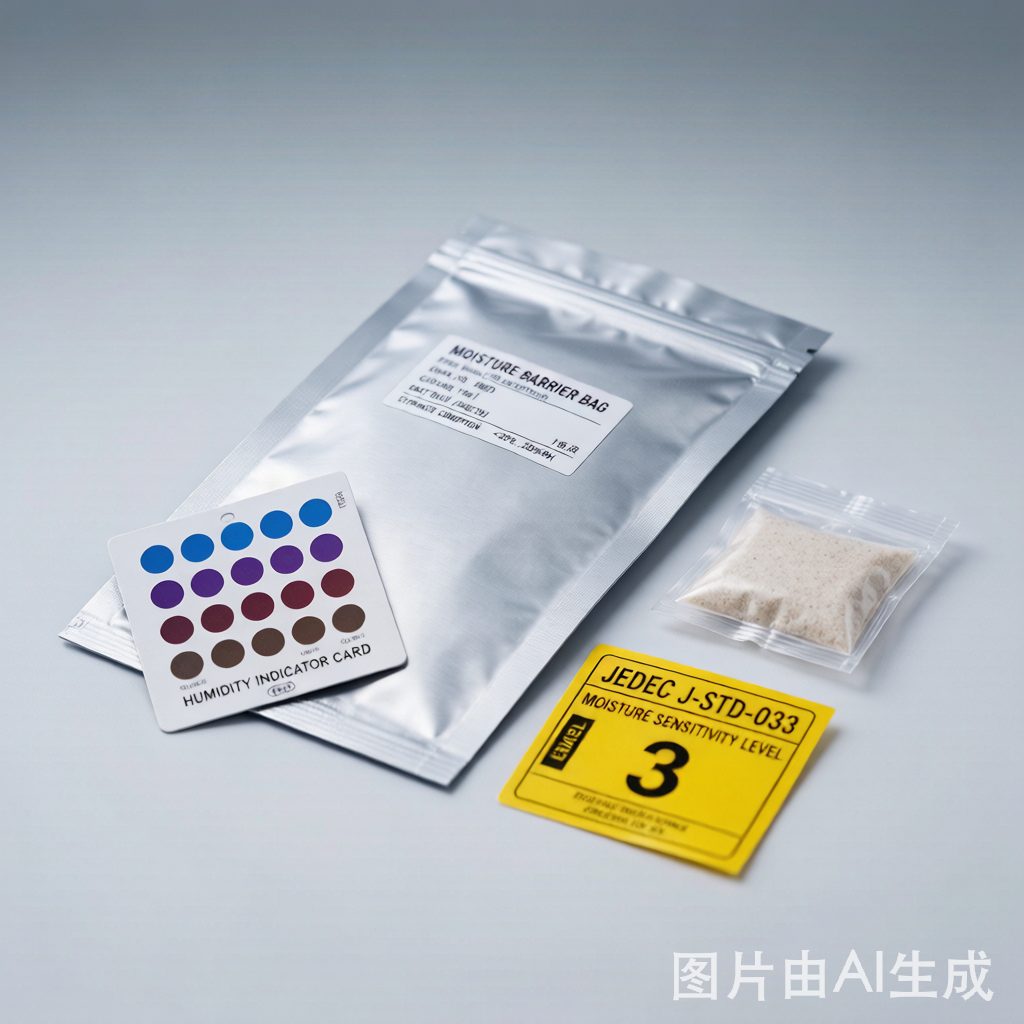
MSL-classified components ship from the manufacturer in vacuum-sealed moisture barrier bags (MBBs) with three key elements:
- Moisture barrier bag: Typically a metalized polyester (VMPET) or aluminum foil laminate bag with water vapor transmission rate (WVTR) below 0.02 g/m²·day. The bag must remain sealed until the components are ready for use.
- Desiccant: Silica gel or molecular sieve desiccant pouches absorb residual moisture inside the sealed bag. Quantity is matched to the bag interior volume and the expected exposure time—typically 1–10 units per bag for a standard MBB.
- Humidity indicator card (HIC): A card with chemically impregnated color-changing dots (typically cobalt-free, blue to pink) that indicate the internal humidity level at the time of bag opening. If the card shows >10% RH (or per the dots’ specification), the components may have been exposed to excessive moisture and require assessment.
The MSL rating, bag seal date, and required handling notes are printed on the MBB outer label, often including a barcode for inventory tracking. The “exposure to factory ambient” clock starts when the bag is opened.
Floor Life Tracking and Manufacturing Discipline
Once an MBB is opened, the floor life countdown begins. Effective MSL management requires:
- Factory ambient monitoring: Maintain SMT floor conditions at ≤30°C and ≤60% RH (or stricter per component specifications). Higher humidity accelerates moisture absorption dramatically—saturated components at 30°C/85% RH reach MSL 3 levels in approximately 1/3 the time of 30°C/60% RH exposure.
- Tracking sheets: When opening MBB bags, log the date, time, MSL rating, and quantity removed. Use the sheet to track accumulated exposure time across multiple partial bag openings.
- Closed-bag storage: Re-seal opened MBB bags with fresh desiccant and a humidity indicator card if components are removed but not immediately used. Tape (not heat) seal the bag; heat sealing can damage the metallized layer.
- Datalogger ambient monitoring: Continuous humidity loggers in the SMT area provide evidence of compliance during quality audits and trigger alerts if conditions drift out of specification.
Baking Procedures: When and How
Components that have exceeded their floor life, or whose MBB humidity indicator shows excessive moisture, must be baked dry before reflow soldering. J-STD-033 specifies baking conditions based on component package thickness and tolerance:
| Package Thickness | Bake Temp | Bake Time | Notes |
|---|---|---|---|
| ≤1.4 mm (thin QFN, TQFP) | 125°C | 8–24 hours | Lower temp to prevent solder/lead finish damage |
| 1.4–2.0 mm (standard SOIC, QFP) | 125°C | 12–24 hours | Standard baking condition |
| 2.0–4.5 mm (large BGA, stacked die) | 125°C | 24–48 hours | Thick mold compound requires longer bake |
| All thicknesses (low-temp parts) | 40°C/≤5% RH | 5–30 days | Use when 125°C bake would damage parts |
Baking is typically done in a nitrogen-purged or forced-air convection oven with temperature uniformity ±5°C throughout the chamber. Standard component reels and JEDEC trays can be baked directly; however, tape and reel cover tape adhesives (especially heat-seal type) can degrade at high temperatures, requiring removal of cover tape before baking in some cases.
Reflow Considerations for Moisture-Sensitive Components
Even properly dried components can absorb moisture between the bake-out and reflow soldering if the production schedule delays. Best practices include:
- Sequencing: Schedule SMT lines to process moisture-sensitive parts immediately after dry-pack opening. Avoid leaving unsealed parts overnight.
- Reflow profile: Use a reflow profile with a controlled ramp rate of 1–3°C/second through the activation zone. Excessive ramp rates increase internal package stress and can initiate cracks even in properly dried parts.
- MSL 2A or stricter handling: For MSL 2A and below, allocate a shorter, well-defined window between MBB opening and reflow. In high-volume production, J-STD-033 recommends opening only the quantity that can be processed within the floor life.
- Dry-cabinet storage: For very-low-volume, high-value parts (military, aerospace), dry cabinets maintained at <5% RH eliminate floor life concerns entirely—parts can be stored indefinitely in dry cabinets without baking.
Detecting Moisture Damage
Even with proper MSL management, occasional moisture damage can occur. Detection methods include:
- Visual inspection after reflow: External cracks, “popcorn” bulges, or visible delamination at package edges indicate moisture damage
- Acoustic microscopy (C-SAM / SAT): Sca
ing acoustic tomography reveals internal delamination between mold compound and die, lead frame, or substrate. Most sensitive detection method for moisture damage.
- X-ray inspection: Can identify severe internal cracks, voids in solder joints, and bridging defects, but less sensitive to delamination than acoustic microscopy
- Electrical test: Damaged packages may pass initial test but fail under thermal stress, bias, or humidity
For high-reliability applications (automotive AEC-Q100, medical, aerospace), pre-reflow acoustic microscopy inspection of large BGAs is increasingly common as a process control measure.
Common MSL Management Mistakes
- Ignoring the humidity indicator card: If the 10% RH dot on the HIC is pink when the MBB is opened, components may have absorbed moisture and need baking—even if the bag was sealed
- Reusing desiccant: Once exposed to ambient, desiccant is partially saturated and may not provide adequate moisture protection in a re-sealed bag
- Storing MBBs in uncontrolled environments: A sealed MBB in a 35°C/80% RH warehouse still ages—the WVTR isn’t zero, just very low
- Baking at the wrong temperature: 150°C or higher temperatures can oxidize copper lead frames, oxidize solder, and damage plastic packages; always follow J-STD-033 recommendations
- Forgetting cumulative exposure: Two 4-day exposures don’t equal one 8-day exposure—re-sealing with fresh desiccant effectively resets the clock
Conclusion
Moisture sensitivity level management is one of the most overlooked but consequential aspects of high-reliability SMT manufacturing. JEDEC J-STD-033 provides the framework for classifying component moisture risk, packaging in proper MBBs with desiccant, tracking floor life, and applying baking procedures when needed. Strict adherence to J-STD-033 throughout the supply chain—from component manufacturer to SMT line—is the most effective defense against moisture-induced package cracking, delamination, and field failures. For high-reliability products, investing in dry-cabinet storage and pre-reflow acoustic microscopy inspection provides additional protection against this entire failure mode.