The 2006 EU RoHS directive eliminated lead from most commercial electronics, triggering a global transition to lead-free soldering. Two decades later, the landscape has settled on a handful of dominant alloy systems — each with distinct processing characteristics, reliability profiles, and cost implications. Choosing the right alloy shapes your entire SMT process window.
SAC305: The Industry Standard
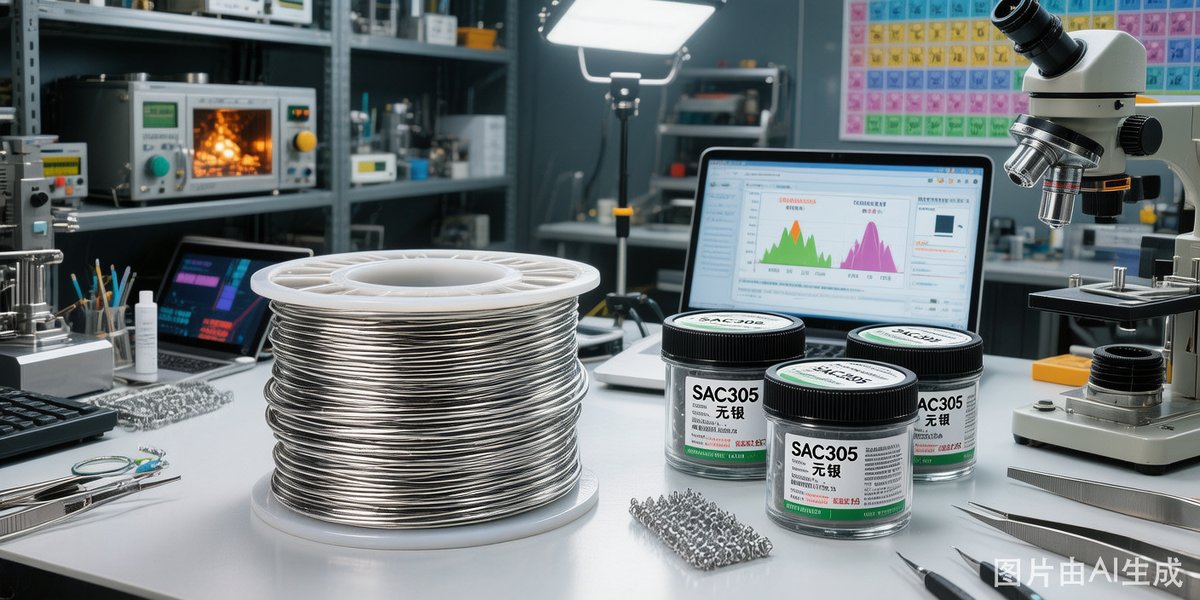
SAC305 (96.5% Sn / 3% Ag / 0.5% Cu) is the dominant lead-free alloy in mainstream electronics assembly. Its 217°C liquidus temperature, good wettability, and proven reliability in IPC-9701 thermal cycling tests have made it the default choice for consumer electronics, automotive, and telecommunications applications worldwide.
Strengths include excellent mechanical strength, broad supplier availability, well-characterized reliability data, and compatibility with most no-clean fluxes. The primary weakness is silver content (3%) making it significantly more expensive than leaded solder, and higher processing temperature (peak 245°C vs 210°C for SnPb) that stresses components and PCB laminate materials.
Low-Silver Alloys: SnAg and SAC0307
Reducing silver content to 0.3% (SAC0307) or eliminating it entirely (SnCu0.7) cuts material cost by 30-40%. These low-silver alloys were developed in response to silver price volatility and are increasingly used in cost-sensitive consumer electronics production where high-volume output requires meaningful material cost optimization.
The trade-off is reduced mechanical strength and lower thermal fatigue resistance compared to SAC305. Low-silver alloys are acceptable for Class 1-2 applications but are not recommended for automotive under-hood or high-vibration environments where long-term solder joint fatigue is a primary concern.
BiSn and SnBiAg: Low-Temperature Alternatives
Bismuth-tin alloys (BiSn: 58% Bi / 42% Sn) offer a dramatically lower liquidus point of 138°C — enabling reflow peak temperatures of 170-180°C. This is transformative for temperature-sensitive substrates (thin flexible PCBs, embedded components), mixed assembly with pre-installed heat-sensitive components, energy savings in high-volume production, and reduced warpage on large complex PCBs.
The challenge with BiSn is bismuth brittleness — the alloy has low ductility and poor drop-shock resistance. Adding silver (SnBiAg: e.g. Sn42Bi57Ag1) improves mechanical properties but increases cost. A critical warning: mixing BiSn with SAC305 during rework produces a ternary alloy with a significantly depressed melting point near 138°C, which can cause unintended joint reflow during subsequent operations.
Alloy Selection Summary
| Alloy | Liquidus | Relative Cost | Best Application |
|---|---|---|---|
| SAC305 | 217°C | High | General electronics, automotive, telecom |
| SAC0307 | 217°C | Medium | Cost-sensitive consumer products |
| SnCu0.7 | 227°C | Low | Wave soldering, Class 1 only |
| BiSn42 | 138°C | Medium | Low-temp substrates, flexible PCBs |
| SnBiAg | 140-150°C | Medium-High | Low-temp plus mechanical strength |
For most SMT operations, SAC305 remains the safest default. Low-silver alloys offer meaningful cost savings in high-volume consumer production. BiSn-based alloys are the emerging choice for next-generation flexible and heterogeneous integration applications where thermal budget is the primary design constraint.