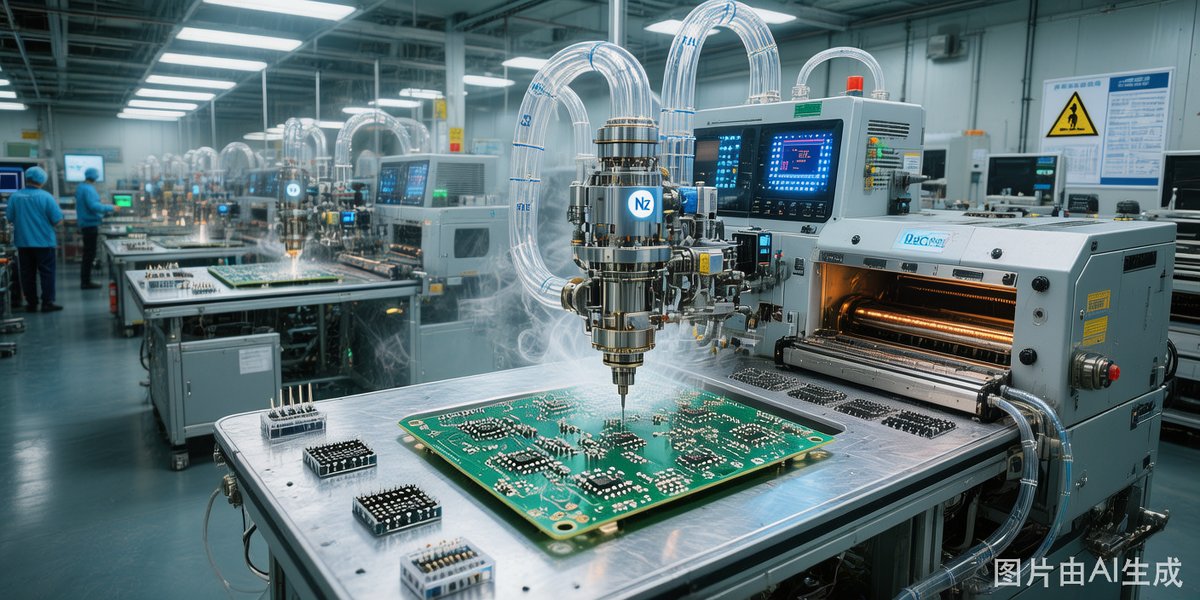
Nitrogen (N2) atmosphere soldering replaces ambient air in the reflow oven with an inert gas, reducing oxygen concentration to below 50-100 ppm. This seemingly simple change has profound effects on solder joint quality, yield, and process latitude — but it comes with real operating costs that require careful ROI analysis.
Why Oxygen is the Enemy of Good Solder Joints
At reflow temperatures, oxygen rapidly oxidizes molten solder and component terminations. Oxidation increases solder surface tension and reduces wetting ability, creates intermetallic oxide layers that weaken joint adhesion, consumes flux activators prematurely, and increases bridging and voiding defect rates. Nitrogen eliminates all of these oxygen-driven degradation mechanisms.
Measurable Benefits of Nitrogen Reflow
| Metric | Air Atmosphere | Nitrogen (<100ppm O2) |
|---|---|---|
| Solder spread (wettability) | Baseline | 15-25% improvement |
| BGA void rate | 8-15% | 2-5% |
| Peak temp requirement | 245°C (SAC305) | 235-240°C |
| Flux residue | Higher activity needed | Milder flux sufficient |
Process Window Expansion
Perhaps the most valuable benefit of nitrogen is the expanded process window. In air, the window between cold joint and component damage can be as narrow as 15°C for heat-sensitive components on complex mixed boards. Nitrogen reflow typically widens this window by 10-15°C, dramatically reducing the sensitivity of yields to oven temperature variations and board-to-board thermal mass differences.
Operating Costs and ROI
Nitrogen consumption for a standard 8-zone inline reflow oven is approximately 15-40 m3/hour depending on oven size and door configuration. At industrial N2 pricing of $0.15-0.30 per m3, this equates to $2-12 per hour. Over three-shift production (6,000 hours/year), a
ual nitrogen costs range from $12,000 to $72,000 USD.
The ROI calculation must account for defect reduction (rework labor plus component cost), flux cost reduction (cheaper no-clean flux becomes viable), and reduced thermal stress on components (fewer latent failures in the field). High-reliability manufacturers consistently report positive ROI at production volumes above 500,000 boards per year.
When Nitrogen is Not Worth the Cost
Nitrogen atmosphere adds marginal value when using high-reliability no-clean flux with sufficient activator, soldering standard through-hole or large-pitch SMT components, operating at low production volumes, or when board complexity does not include fine-pitch BGA or 0201 components. In these cases, a well-optimized air profile with premium flux delivers equivalent results at significantly lower operating cost.