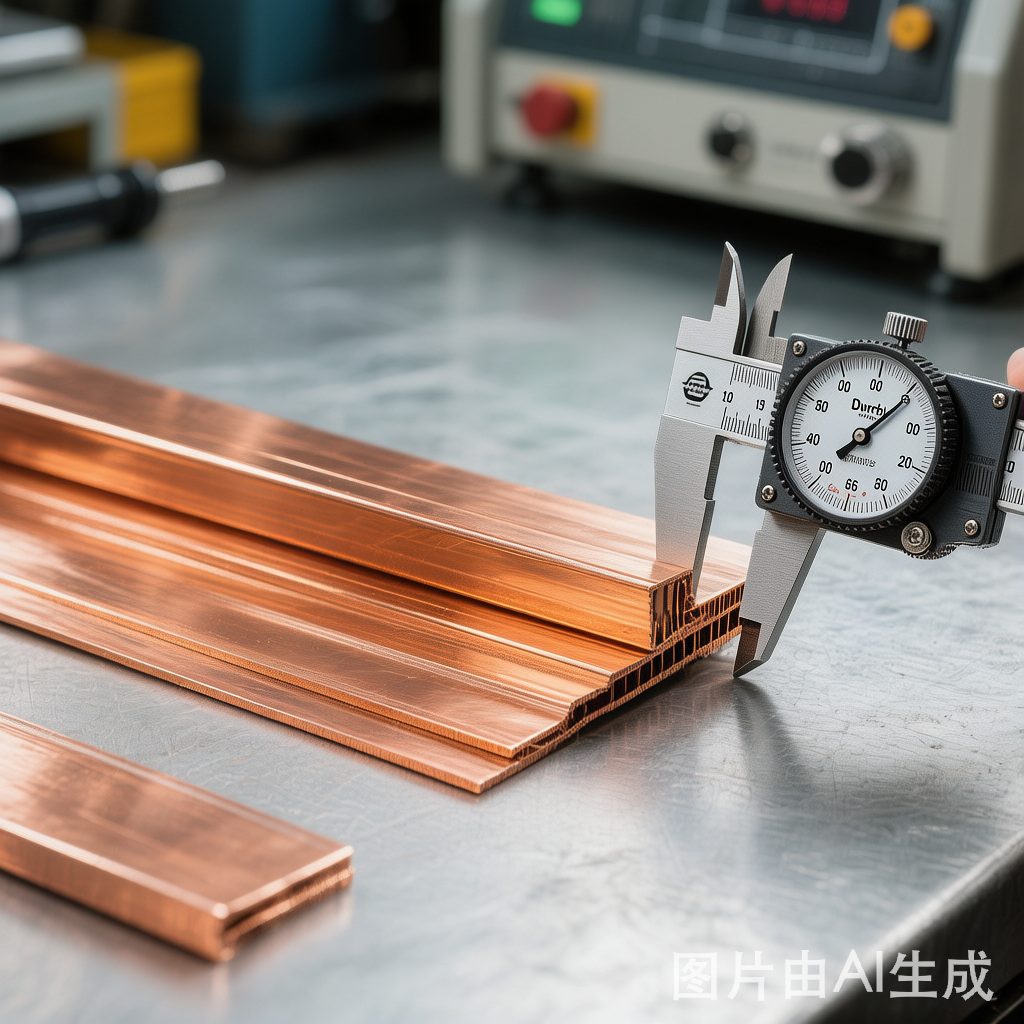
Copper strip thickness is one of the most consequential yet underappreciated design parameters in SMT thermal and electrical applications. Whether you’re selecting a heat-spreading interposer for a power module, a grounding strap, or an EMI shield clip, the thickness directly affects thermal performance, current capacity, mechanical compliance, and reflow compatibility. This guide provides a practical framework for choosing between the most common SMT copper strip gauges.
Thermal Conductivity vs. Thickness
Pure copper has a bulk thermal conductivity of ~385 W/m·K — one of the highest of any engineering metal. However, in SMT applications, the effective thermal resistance depends on both the copper thickness and the interface contact quality:
Thermal resistance (R_th) = Thickness ÷ (Thermal Conductivity × Area)
For a 10 × 10 mm copper strip:
| Thickness | R_th (K/W) | Primary Use Case |
|---|---|---|
| 0.1 mm | 0.026 | Flexible thermal bridges, fine-pitch EMI clips |
| 0.2 mm | 0.052 | General thermal pads, grounding straps |
| 0.3 mm | 0.078 | Medium-power heat spreaders |
| 0.5 mm | 0.130 | High-current busbars, power module substrates |
| 1.0 mm | 0.260 | Heat sinks, high-power baseplate applications |
Thi
er copper offers lower absolute thermal resistance for the same footprint, but the advantage diminishes if the interfacial thermal resistance (solder joint or TIM) dominates.
Current Carrying Capacity by Thickness
For power distribution applications, the current carrying capacity (ampacity) scales with cross-sectional area:
| Thickness (10mm wide strip) | DC Ampacity (40°C rise) | AC Ampacity (60 Hz, 40°C rise) |
|---|---|---|
| 0.1 mm | ~4 A | ~3.5 A |
| 0.2 mm | ~8 A | ~7 A |
| 0.3 mm | ~12 A | ~10 A |
| 0.5 mm | ~20 A | ~17 A |
| 1.0 mm | ~40 A | ~32 A |
Mechanical Compliance and Reflow Compatibility
Thi
er copper strips offer greater mechanical compliance — they flex to accommodate PCB warpage and CTE mismatch between the copper (17 ppm/°C) and FR4 substrate (14–18 ppm/°C). Key reflow considerations:
- 0.1–0.2 mm strips: Low thermal mass — these reach reflow temperature quickly. Use a slow ramp rate (1–2°C/s) to prevent premature solder melting before the strip seats properly. High flexibility makes them suitable for curved board surfaces.
- 0.3–0.5 mm strips: Higher thermal mass requires longer soak zones to ensure uniform heating. The increased stiffness helps maintain coplanarity under the component but may crack solder joints on boards with high warpage. SAC305 solder with ≥ 60 second soak at 200–217°C is recommended.
- ≥ 1.0 mm strips: These are generally too thick for standard SMT reflow and are better suited for mechanical fastening or press-fit applications.
Surface Finish and Thickness Interaction
The plating type interacts with thickness selection:
- Bare copper (unplated): Oxidizes within days in humid environments. Use only when soldered immediately or protected by conformal coating. Suitable for all thickness ranges.
- Nickel-plated copper: 2–5 µm Ni provides oxidation resistance. For thin (0.1 mm) strips, ensure the Ni layer does not significantly increase stiffness — verify flexibility before adoption.
- Gold-plated copper (Au/Ni): 0.05–0.15 µm Au over 2–4 µm Ni. Best solderability and corrosion resistance, ideal for fine-pitch 0.1 mm strips where surface cleanliness is critical for reliable joint formation.
Practical Selection Checklist
- ✅ Need flexibility / CTE compliance → 0.1–0.2 mm
- ✅ Need current capacity ≥ 10A → 0.3 mm or thicker
- ✅ Need stiffness to maintain coplanarity → 0.3–0.5 mm
- ✅ SMT reflow process, no mechanical fastening → ≤ 0.5 mm
- ✅ High humidity / outdoor environment → Au/Ni plating on any thickness
- ✅ EMI shielding clip (spring contact) → 0.15–0.25 mm for spring compliance
TechMartSE supplies copper strips from 0.05 mm to 2.0 mm in bare copper, nickel-plated, and gold-plated finishes. Custom widths from 1 mm to 50 mm are available with lead times of 3–7 business days for standard specifications. Contact our engineering team for application-specific thickness recommendations based on your thermal simulation data or power dissipation requirements.