## Introduction
Alloying engineering plastics such as polycarbonate (PC), polyamide (PA), polybutylene terephthalate (PBT), and acrylonitrile butadiene styrene (ABS) is a common route to balanced mechanical, thermal, and aesthetic properties. The challenge is that most of these polymers are immiscible and form coarse phase morphologies with poor interfacial adhesion. Compatibilizers are added to bridge the phases, refine the morphology, and improve impact strength, ductility, and heat resistance.
Two widely used compatibilizer families for ABS-based alloys are styrene-acrylonitrile-glycidyl methacrylate (SAG) and ABS grafted with maleic anhydride (ABS-g-MAH). They share a common purpose but differ in chemistry, reactivity, and the alloy combinations they suit.
This article compares SAG and ABS-g-MAH across three commercial alloy systems — PC/ABS, ABS/PBT, and ABS/PA — and provides selection guidance for polymer compounders.
## Compatibilizer Chemistry
### SAG: Epoxy-Functional SAN Copolymer
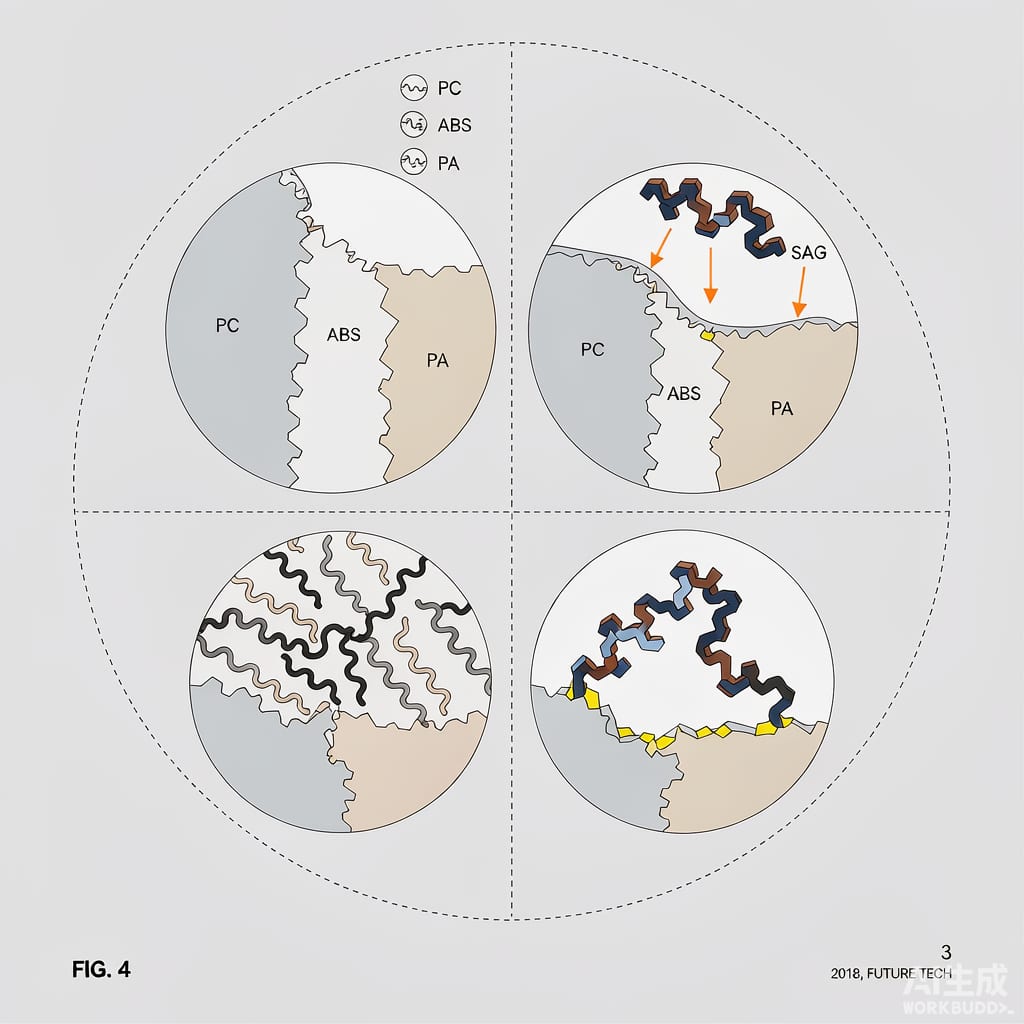
SAG is a random or graft copolymer of styrene, acrylonitrile, and glycidyl methacrylate. The epoxy group in the glycidyl methacrylate unit reacts with carboxyl, amine, and hydroxyl end groups on polycondensation polymers such as PC, PBT, and PA. The styrene-acrylonitrile backbone is miscible with the SAN matrix phase of ABS, so the SAG molecule anchors at the interface between the ABS phase and the engineering plastic phase.
Typical GMA content in SAG is 5–25% by weight. Higher GMA content increases reactivity but reduces thermal stability during compounding.
### ABS-g-MAH: Maleic Anhydride Grafted onto ABS
ABS-g-MAH is produced by reactive extrusion of ABS with maleic anhydride and a free-radical initiator. The MAH grafts onto the polybutadiene or SAN backbone. The anhydride group reacts with amine end groups in polyamide and with hydroxyl end groups in PBT. It does not react with polycarbonate, which limits its use in PC/ABS alloys.
MAH content is typically 0.5–2.0% by weight. Higher MAH content increases reactivity but can cause crosslinking and gel formation during compounding.
## Performance in PC/ABS Alloys
### SAG in PC/ABS
PC/ABS is the largest commercial alloy system for notebook housings, charger enclosures, and automotive interior parts. SAG is the dominant compatibilizer for PC/ABS because the epoxy groups react with the hydroxyl end groups of polycarbonate, while the SAN backbone provides miscibility with the ABS phase.
At typical loadings of 1–3 phr, SAG raises the notched Izod impact strength of a 70/30 PC/ABS blend by 40–80% compared with the uncompatibilized control. Heat deflection temperature under load (HDT) also improves because the refined phase morphology resists deformation.
### ABS-g-MAH in PC/ABS
ABS-g-MAH is less effective in PC/ABS because the anhydride group does not react efficiently with PC. Some commercial PC/ABS grades use ABS-g-MAH in combination with an epoxy-functional additive, but the simpler and more common solution is SAG.
## Performance in ABS/PBT Alloys
### ABS-g-MAH in ABS/PBT
ABS/PBT blends combine the heat resistance and chemical resistance of PBT with the surface appearance and impact strength of ABS. The two polymers are highly immiscible because PBT is a semi-crystalline polyester and ABS is an amorphous styrenic blend. ABS-g-MAH is widely used to compatibilize ABS/PBT. The anhydride reacts with the hydroxyl end groups of PBT, while the ABS backbone grafts into the ABS phase.
ABS-g-MAH at 2–5 phr reduces PBT domain size from several microns to sub-micron dimensions and dramatically improves the impact strength and ductility of the blend. Hydrolytic stability is improved as well because the finer morphology slows water penetration.
### SAG in ABS/PBT
SAG is also used in ABS/PBT, but its reactivity is lower than that of ABS-g-MAH toward PBT hydroxyl end groups. SAG is generally less efficient than ABS-g-MAH in ABS/PBT at the same loading.
## Performance in ABS/PA Alloys
### ABS-g-MAH in ABS/PA
ABS/PA blends combine the heat resistance and chemical resistance of polyamide with the impact strength and surface quality of ABS. ABS-g-MAH is the standard compatibilizer for ABS/PA. The anhydride reacts with the amine end groups of PA6 or PA66, forming a strong imide linkage that anchors the polymer chains across the phase boundary.
At 3–7 phr loading, ABS-g-MAH raises the impact strength of a 50/50 ABS/PA blend by 50–100% and improves the elongation at break by an order of magnitude. The fine morphology also improves surface gloss.
### SAG in ABS/PA
SAG is less effective in ABS/PA than ABS-g-MAH because the epoxy group reacts more slowly with amine end groups than anhydride does. SAG may be used in hybrid systems with ABS-g-MAH or with an impact modifier such as maleated EPDM to fine-tune the balance of stiffness and toughness.
## Hydrolysis and Aging Stability
### Hydrolytic Stability of the Linkage
Both the epoxy-anhydride and the anhydride-amine linkages can hydrolyze under high humidity and elevated temperature. The hydrolytic stability of the maleimide linkage from ABS-g-MAH in PA is generally better than the epoxy linkage from SAG in PC because the imide is more resistant to hydrolysis.
For underhood automotive applications and outdoor enclosures exposed to tropical humidity, ABS-g-MAH/PA systems with proper stabilization can pass 1000-hour 85 °C/85% RH aging tests, while SAG/PC systems may show some property loss under the same conditions.
### Long-Term Heat Aging
In long-term heat aging at 120–150 °C, both compatibilizer systems can show property loss because the interfacial linkages slowly break. Adding a phenolic antioxidant and a phosphite stabilizer extends the useful life of either system.
## Processing Considerations
### Compounding Order
For SAG systems, the high reactivity of the epoxy group means that the compounding temperature and residence time must be carefully controlled. Excessive temperature or residence time causes crosslinking and gel formation. For ABS-g-MAH systems, the compounding window is generally wider, but excessive free-radical initiator can also crosslink the ABS and reduce flow.
### Effect on Melt Flow
Both compatibilizers raise the melt viscosity of the alloy because the interfacial reaction products increase molecular weight at the interface. SAG typically raises melt viscosity more than ABS-g-MAH at equivalent loading, which can complicate injection molding of thin-wall parts.
## Selection Guidance
The choice between SAG and ABS-g-MAH depends on the matrix polymer and the target properties.
– For PC/ABS alloys, SAG is the default choice because it reacts with the PC hydroxyl end groups.
– For ABS/PBT alloys, ABS-g-MAH is generally preferred because of its higher reactivity with PBT and better hydrolytic stability.
– For ABS/PA alloys, ABS-g-MAH is the standard compatibilizer.
– For hybrid systems such as PC/PBT and PC/PA, a combination of SAG and ABS-g-MAH is often used.
## Conclusion
SAG and ABS-g-MAH are complementary compatibilizer families for ABS-based engineering plastic alloys. SAG is the workhorse for PC/ABS, while ABS-g-MAH dominates ABS/PBT and ABS/PA. Understanding the chemistry of each compatibilizer and matching it to the matrix polymer end groups is the key to a well-balanced alloy with good impact strength, heat resistance, and long-term durability.