## Introduction
Bare copper strip remains the material of choice for SMT leadframes, busbars, and stamped terminals because of its excellent electrical conductivity and cost position. However, copper’s affinity for oxygen means that freshly slit or rolled strip begins to form a tarnish film within hours of exposure to air. At elevated humidity and temperature — common in Southeast Asian manufacturing environments — that tarnish can progress to a thick copper oxide layer that degrades solder wetting, increases wetting balance time, and raises the risk of voids and poor intermetallic compound (IMC) formation during reflow.
This article reviews the chemistry of copper oxidation in SMT applications, explains how surface treatments extend solderability shelf life, and provides procurement specifications that ensure bare copper strip arrives production-ready rather than already degraded.
## Copper Oxidation Mechanisms in SMT Strip
### Oxide Film Growth Kinetics
Copper oxidizes in air through two distinct regimes. At room temperature, a thin Cu2O film forms rapidly and reaches a self-limiting thickness of roughly 5–10 nm within the first day. This initial film is not a major barrier to soldering because flux can reduce it easily. The problem begins when the Cu2O converts to CuO in the presence of moisture and oxygen over longer periods, or when the strip is exposed to temperatures above 60 °C during storage or transit.
Thicker oxide films require more aggressive flux activity and longer time above liquidus to achieve complete wetting. In no-clean solder paste processes with mild flux, a pre-existing CuO layer may not be fully reduced, leaving un-wetted areas or coarse IMCs that weaken the joint.
### Contamination Beyond Oxides
In addition to oxides, bare copper strip can accumulate fingerprints, residual rolling oil, sulfide stains from packaging materials, and chloride residues from degreasing baths. Each of these contaminants raises the wetting force threshold and can cause non-wetting in fine-pitch components where solder volume is limited.
## Surface Treatments for SMT Copper Strip
### Anti-Tarnish Oils and Volatile Corrosion Inhibitors
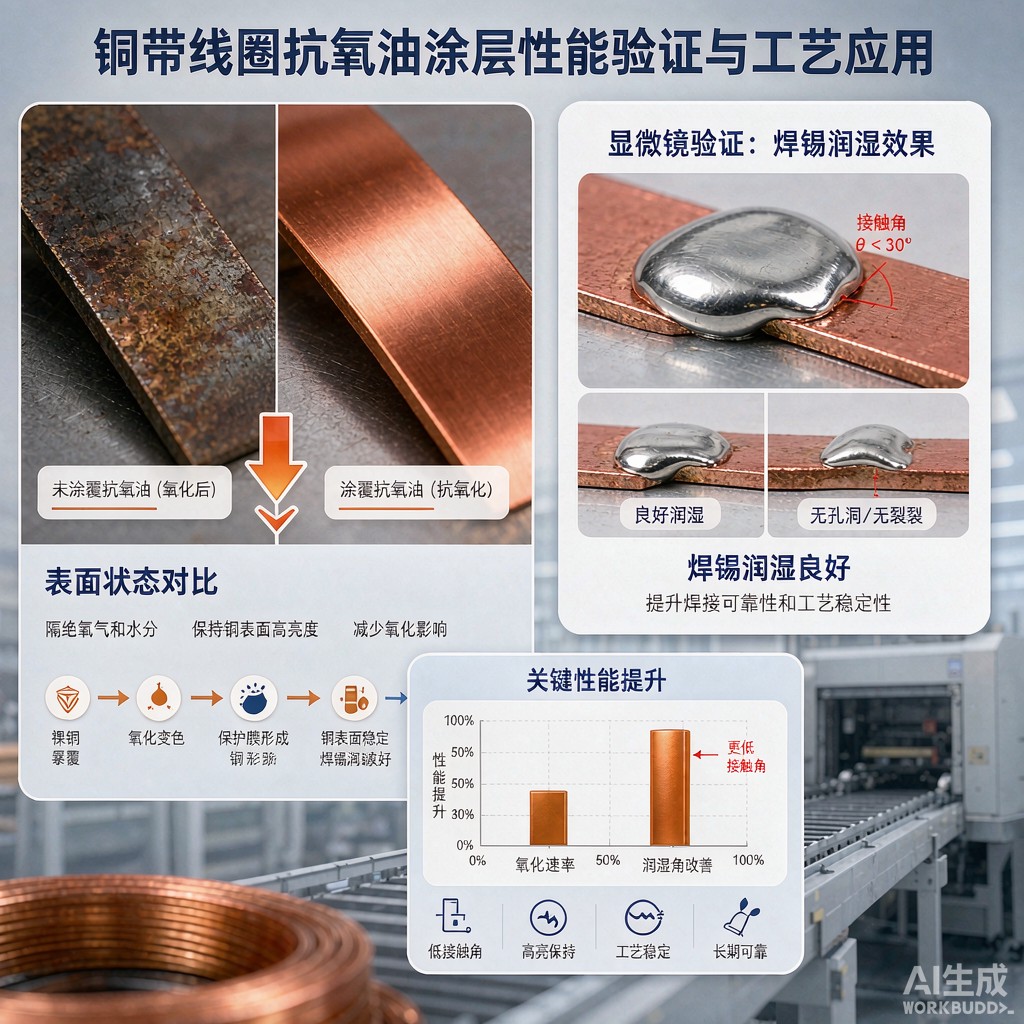
The most common protection method is a thin, non-silicone anti-oxidation oil applied immediately after slitting. These oils typically contain benzotriazole derivatives or fatty acid esters that form a molecular barrier against oxygen and moisture. A well-applied anti-tarnish oil can extend solderability from a few days to 3–6 months under warehouse conditions.
For SMT applications, the oil must be compatible with water-soluble and no-clean fluxes, and it must not leave a residue that interferes with AOI or electrical testing. The coating weight is usually controlled to 0.5–2.0 g/m². Heavier coatings can cause solder balling; lighter coatings may not protect the edges, which are the most vulnerable area.
### Chromate-Free Conversion Coatings
Hexavalent chromium conversion coatings were once standard for copper corrosion protection, but environmental regulations have driven a shift toward trivalent chromium, zirconium-based, and organic-silane alternatives. These conversion coatings provide a thin, electrically conductive surface layer that improves solderability compared with bare oxide and offers modest corrosion resistance.
The trade-off is that conversion coatings add a small contact resistance and may alter the surface energy of the strip. For high-current busbar applications, the coating must be thin enough that crimped or welded joints remain low-resistance after assembly.
### Tin and Nickel Pre-Plating
Where longer shelf life is required, bare copper strip can be pre-plated with matte tin, nickel, or nickel-gold. These plated finishes eliminate the oxidation concern entirely but change the cost and processing envelope. For example, tin-plated copper strip is popular in press-fit and through-hole applications because the tin coating melts into the solder joint; however, it is generally not considered ‘bare copper strip’ for procurement purposes.
## Storage and Handling Best Practices
Even the best surface treatment can be undermined by poor storage. Bare copper strip should be kept in a climate-controlled warehouse with relative humidity below 60% and temperature below 30 °C. Coils should remain sealed in their original VCI packaging until just before use. Once opened, unused material should be re-wrapped or placed in a desiccant cabinet to limit re-oxidation during line changeovers.
Handling with bare hands should be avoided because skin oils contain chlorides and fatty acids that accelerate localized tarnishing. Operators should wear lint-free gloves when feeding coils into stamping or forming equipment. Cleanroom-grade gloves are not required for most SMT strip applications, but powder-free nitrile gloves are a reasonable minimum.
## Procurement Specifications
When purchasing bare copper strip for SMT, request the following on the mill test report:
1. Oxide thickness or reflectivity measurement: A bright, oxide-free surface should show a mirror reflectance above 70% at 600 nm, or an oxide thickness below 20 nm by ellipsometry.
2. Anti-oxidation coating type and weight: Confirm whether the oil is silicone-free and flux-compatible.
3. Solderability test result: A dip-and-look test per IPC-J-STD-002 or a wetting balance curve showing wetting force above 80% of the maximum theoretical value at 2.0 seconds.
4. Packaging: VCI paper and moisture-barrier film with desiccant to limit humidity during ocean freight.
## Conclusion
Bare copper strip is an excellent conductor, but only when it reaches the SMT line in a solderable condition. The right combination of slitting cleanliness, anti-oxidation treatment, and protective packaging can extend shelf life from days to months, reducing rework and improving first-pass yield in humid climates.